Tuesday, June 9, 2009

Witnessing: Barth, Cixous, and the Art of Writing


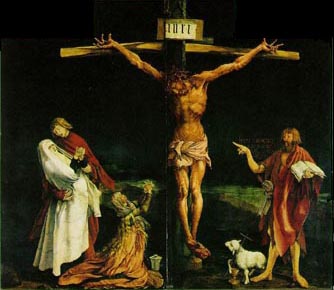
"Witnessing means pointing in a specific direction beyond the self and on to another. Witnessing is thus service to this other in which the witness vouches for the truth of the other, the service which consists in referring to this other...Standing in this service, the biblical witnesses point beyond themselves...One might recall John the Baptist in Grunewald's Crucifixion, especially his prodigious index finger. Could anyone point away from himself more impressively and completely ('he must increase, but I must decrease')...This is what the Fourth Evangelist wanted to say about this John, and therefore about another John, and therefore quite unmistakably about every 'John.'" Karl Barth, CD I.1.4.3, 109-110 [112].

So much to say about this painting--but we are only following one path here, the path to which Barth points us, the path of pointing away. Follow the prodigious finger.

To go ahead and say it: the phallic finger. Prodigious--extraordinary in size, abnormal, a miracle perhaps. Or a monstrosity. Perhaps all--that prodigious finger is not an end in itself. What it is--abnormal, excessive, monster, miracle--comes not from within, but from without. From where it points. Or, to whom. But Barth is right: it is a prodigious finger/phallus.

The object of desire, the one to whom the finger points: the monstrosity of (as) Christ. The prodigy, prodigium, Latin for monster. Or omen. Christ, the prodigy, the monstrous omen. "The prodigy is not only prewarning, but activation of the calamity at hand" (__Greek and Indo-European Etymology in Action: Proto-Indo-European *aǵ-__, Raimo Anttila, 114). The prodigious finger pointing away, pointing to the prodigy, the calamity at hand, the death of Christ.

Here we enter into the undoing. The phallic finger does not inscribe itself. It is not the goal, or object of attention. It exists in the painting as a sign, as a witness, as something to move past. It is magnified, enlarged, made prodigious so as to draw attention to its shrinking. Above the finger, it is written: he must increase but I must decrease. Enlarged, to draw attention to its shrinking. To his shrinking. To he shrinking.

Let us turn from shrinking and look at the large--and grotesque--feet of Christ. With the nail through the center, and blood dripping off the individual toes. The feet must have died first. They look ashen; even more than the rest of the dead, diseased, broken, bloody body. (I remember stories, in the Bible, about covering feet, and laying at the feet, and recall: a euphemism). Prodigious, dead feet.

Jesus' hands are also unusual. His fingers point--not to another person in the painting, but to the one absent, God, above. If there were time--I'm trying not to ramble...--we could examine those hands. One other person imitates those splayed fingers--Mary Magdalene, the smallest figure in the painting. Also, the only other one (besides Jesus) who isn't standing on her feet. The prodigious finger, pointing away from itself, towards the one with opened, uncontrolled, grasping hands. And thoroughly dead feet. (He came in the likeness of sinful flesh...).

"Writing is a passageway, the entrance, the exit, the dwelling place of the other in me--the other that I am and am not, that I don't know how to be, but that I feel passing, that makes me live--that tears me apart, disturbs me, changes me, who?--a feminine one, a masculine one, some?--several, some unknown, which is indeed what gives me the desire to know and from which all life soars. This peopling gives neither rest nor security, always disturbs the relationship to "reality," produces an uncertainty that gets in the way of the subject's socialization. It is distressing, it wears you out; and for men, this permeability, this nonexclusion is a threat, something intolerable" (Cixous, Sorties, in __The Newly Born Woman__, 86).

The permeability, the vulnerability, speaks of the end of self-mastery. Christ is the end of self-mastery. The death of human autonomy (self-government); the shriveling up of the enlarged...feet. For men, this is a threat. He must increase, I must decrease. The object of desire--the one to whom John's prodigious finger points--the crucified Christ. The death of the "phallogocentric" economy. Desired. Desirable. Lovely and teeming with life.

Cixous emphasizes writing; she performs a new writing, one not intoxicated by the desire to contain, conquer, control. Free from self-mastery, which involves (by necessity) an opposition to others: I, not you, am master. Beyond mastery, a different space, another way to write, another way to live, another way to relate. She thinks she's merely dreaming.

"Without the ambivalence, the liability to misunderstanding and the vulnerability with which [preaching] takes place, with which it is itself one event among many others, it could not be real proclamation" (Barth, 91 [94]). God speaks--the event of God's Word occurs--not in spite of, but through the weakness of our proclamation. To be a witness is to be weak. To be a witness is to have one's whole life amount to the task of pointing away, of highlighting not the self, but another. Not any other, either. But the Wholly Other--the Weakest Other, God in flesh.

Barth sometimes downplay the importance of the human form, the style of the presentation ("dogmatics does not seek to give a positive, stimulating and edifying presentation," p. 80 [82]). But he fundamentally recognizes its importance. The form does not guarantee that God speaks. God speaks always out of God's freedom. Nevertheless, one can point to Christ in a way that actually points to oneself (the kingdom of the Selfsame, in Cixous' terms). One can witness to one's strength; which means one can point away from Christ, and thus, even in the form of witnessing, one can fail to witness at all. The form matters. The way we write matters. It displays who we think we are, and, by God's grace, the one to whom we point.

To write in a way that embraces the dead, prodigious, monstrous, saving omen of Christ. And his dead feet. A challenge. Joyful, exhilarating, and terrifying. "For men, this permeability, this nonexclusion is a threat." The threat of losing control. "She lets the other tongue of a thousand tongues speak--the tongue, sound without barrier or death" (Sorties, 88). A beautiful picture of the feast we celebrated two weeks ago--Pentecost. Life beyond the dead feet. Come, Holy Spirit.

Friday, June 5, 2009

Thoughts on John 20:19-23

When it was evening on that day, the first day of the week, and the doors of the house where the disciples had met were locked for fear of the Jews, Jesus came and stood among them and said, "Peace be with you."  After he said this, he showed them his hands and his side.  Then the disciples rejoiced when they saw the Lord.  Jesus said to them again, "Peace be with you.  As the Father has sent me, so I send you."  When he had said this, he breathed on them and said to them, "Receive the Holy Spirit.  If you forgive the sins of any, they are forgiven them; if you retain the sins of any, they are retained."

It was evening on that day, the same day, the first day of the week.  Earlier that day, before the evening gathering, before the doors were locked, when the morning darkness still lingered, Mary Magdalene approached the tomb--we know not why--and saw that the stone no longer blocked the entrance.  The stone had been removed and the  tomb was--empty.  She ran back to the disciples--who had not gone to the tomb with Mary, we know not why--and Peter and John joined her back at the tomb.  They entered into the open tomb, saw the discarded linen wrappings and the carefully folded cloth that had covered Jesus' face, but Jesus was gone.  The disciples did not linger but returned to the house.  

The disciples left, but Mary stayed, weeping outside of the tomb, weeping for the lost body of Jesus.  Two angels appear--though Mary does not see them as angels--and ask her why she is weeping.  She tells them and then, right after she finishes speaking, she sees Jesus standing there--though she thinks him a gardner.  She tells the gardner to help her locate the misplaced body of Jesus, but the gardner speaks her name, and she hears--and then she sees, the Lord.  She returns to the disciples, to the house where, later that same evening, the door will be locked.

When it was evening, on this day, the first day of the week, after Mary, Peter and John had entered the empty tomb, after Mary had heard Jesus' voice call her name and had seen the risen Lord, once the disciples had gathered together, and once the doors of the house where they met had been locked for fear of the Jews, when all of these events had finally lined up (or been strung together), Jesus came and stood among them.

Jesus enters--but not through the door.  Jesus enters through the locked door.  It is no mere demonstration of his power, a new trick, a test drive of the new, resurrected body (I wonder if this thing will pass through walls...).  No, Jesus--whom they now know, or at least should now know to be alive, resurrected--is locked out.  Why?  Fear of the Jews.  

The doors of the house where the disciples had met were locked for fear of the Jews.  The place of entry--locked.  Unlike the tomb.  The stone was removed; but the doors were locked.  Why was the stone removed--why not pass through it like the locked doors?  Or, conversely, why not knock on the door?  An open passage way and a closed one.  For the one person who needs no passage way, for the one person who is the passage way (I am the gate...).  

The door, the stone.  The place of transition, and mechanisms to prevent transition:  locked doors, covered tombs.  And the fear of the Jews.  Why are they afraid?  And what good do they think a locked door will do?  You don't have to be resurrected to get past a locked door.  Why are they hiding?  Do they not believe Mary?  Or are they afraid--not only of the Jews, but of Jesus.  Perhaps.  Is it not the case that our fear of others and our fear of God are related?  Our failure to trust God leads to locking the doors against others.  Locking the doors, fearing the Jews, closes us off from God.  The door, the place of transition, is closed.  To "the Jews," and hence also to Jesus.  To lock out "the other" necessitates locking out Jesus.  

Jesus doesn't condemn the locked door.  He bypasses it.  He comes into the place he is excluded.  And his first words, "Peace be with you."  He passes through the blockade and stands in our midst.  He has no need to coerce us into letting him in.  He enters through the locked door, affirms his and our peace, and shows his wounds.  Then the disciples rejoiced.  The order is not peace, rejoice.  But peace, the displaying of his wounds, and then rejoicing because we finally see the Lord (why does Mary not need to see the wounds but only hear her name...?).  

The door that closes out the other, and closes out Jesus, has been circumvented.  Bypassed.  Passed through, and rendered useless.  Peace offered, wounds examined, vision restored--rejoice.  And now, the repetition.  Jesus repeats the peace.  The first peace restored.  What is the point of this new peace?  Is it mere repetition?  No, it is a peace not only to be reconciled, but to be sent out.  As the Father has sent me, so I send you.  Receive the Spirit.  

After passing through the locked door, Jesus sends us out.  Out of the locked door.  With the first peace, Jesus bypasses our locked doors.  With the second peace, he sends us out of the room.  Beyond all locked doors.  Sent as Jesus was sent.  By the Father, through the Spirit.  Sent like Jesus, the one whose wounds were just displayed.  Sent out, away from the locked doors.  Sent out vulnerable, weak, compassionate.  Wounded.  Filled with the Holy Spirit.  

It is not a calling we want.  We prefer locked doors.  We would prefer closed tombs.  The one who left the tomb moves through our locked doors.  The first peace is scary, but comforting.  The one we love--alive, and at peace with us.  But the second peace--to be sent out, like him, that is too much.  We do not want it.  We cannot sustain it.  We like our locked doors.  Receive the Holy Spirit.

If you forgive the sins of any, they are forgiven them; if you retain the sins of any, they are retained.  How can we retain the sins of any if we are sent out in the form, pattern, and image of Jesus, the one sent to subsume all sin?  How can we refuse to forgive sin when we know we would rather lock our doors and hide in our self-created (and hence false!) sense of security?  We who are terrified of that second peace--and thus know ourselves to be sinners--how can we do anything but rejoice in the forgiveness of sins?  

The Spirit of Jesus, the Spirit of him who came bypassed all barriers, who is himself the point of transition, the Spirit of this one, the risen Jesus, given to us.  Not offered to us (would you like the Spirit, it's pretty great, it fulfills your needs and will sustain your life, come on, you know you want it, it will really deepen your piety and liturgical performance and social justice...please...).  Not offered or explained, but given.  Before we have a chance to say no.  Before we think again about what he just said, before we realize what it means to be sent as Jesus was sent.  Given to us--as grace.  As encounter.  Regardless of our locked doors, our fears, weakness, insecurity, bigotry, and sinfulness.  Encountered by grace.  Filled by the Spirit, and told:  step out of your hiding place, abandon your post behind locked doors, and be sent--out, unafraid, weak and vulnerable, into a world radically transformed, a world in which all barriers are meaningless because the excluded One has risen.  Sent out.  To a world where there are, ultimately speaking, no "others" because there are no truly locked doors.  


Thursday, May 28, 2009

unmasking the unmasked

In "Unmasked!", Cixous examines the Theatre as a place free from misogyny, a space free from "countless symptoms, stiffness, blindness, treachery, uneasiness, hypocrisy, death and rape drives, denial" (179).  What I find interesting, and want to look at briefly, is how Cixous tries to ground the religious on a kind of misogynistic hatred of "the unclean" and yet, in the end, her exploration of Theatre deploys not just religious language, but also the same kind of binary oppositions she wants to avoid.

The religious, for Cixous, operates along the logic of clean-unclean.  The Bible (she quotes from Leviticus) creates clear boundaries, inside-outside, and outside is a "no man's land," meaning, the outside, is the feminine.  A woman giving birth to a son is unclean for a week; for a daughter, the uncleanness lingers, twice as long (Cixous, 173-74).  The unclean is not just the outside, it is at the boundary, or a place of mixture.  Cixous declares that true writing is a "free traveler along edges and abysms...That writing suffers in fact the fate of birds, women, the unclean" (174).  Through the economy of cleanliness, the world becomes divided, separated, and built on oppositions.  No longer is creation seen down at the root, where "nothing is simple," where everything is "twisted, doubled up, entangled" (175).  

Cixous turns to Theatre as a refuge from this religious economy (or order) of cleanliness.  In Theatre, all boundaries become blurry, and therefore everyone, male and female, lives in a kind of (feminine) border area, a "no man's land."  To enter into the Theatre, as an actor, is to become undone, "stripped from head to foot down to one's self" (179).  The actors lose themselves; they become unknown, disfigured, "practically to the point of becoming nobody" (180).  The mask comes on, and now the person(a) is a new person(a).  The mask prevents the stripped-self from "getting its face back" (180).  All who enter are negated:  "one woman one man or the other, the space is ready to receive them without distinction, as to sex, age, race.  There is no particularity" (180); the Theatre is a "kingdom that stretches beyond oppositions and exclusions" (181).  In the Theatre, in acting, we come to know that "all creatures contain infinite possibilities of being an other.  One possibility is just as good as another" (182).

Yet, this theatrical space is reconfigured and spoken of only in terms of inside-outside, of inclusion and exclusion, and hence, as a religion.  The Theatre "was once a Temple...and doesn't forget it" (179).  Is this a Temple-beyond, a truly new space, a new kingdom?  Or does it also bring with it the same logic and the same code?  

I shall speak about the actors.  They have arrived.
Undecided, detached, undressed, without any rank, unarmed, without any particularity.  Joyously prepared for fate.  There are no brothers, there are no wars.  He might have been she....They have become unknown  (179).

Religious idealism at its best!  A glorious scene, the kingdom fulfilled, here and now, in our midst, and I am....inside!  

For there are 'the happy few,' a small number, the miracles, a handful of charming grains of sand in the desert of millennia.  (177).

And I am...she is....one of those few!  I do not favor closing borders, I exist on the boundaries, and thus, I am...inside.  A new inside.  The boundary as the inside.  "This extreme boundary state can last only so long as it is performed, acted, created" (182).  Theatre is, therefore, liturgy, or ritual, whereby I am brought from the outside into the inside, into the kingdom.  And the kingdom is here, at the Temple of Theatre, and not there, not elsewhere.  

To be in the kingdom is to be beyond particularity--there is no particularity.  The kingdom of the boundary, the kingdom of difference is now the universal kingdom.  Difference so wide spread, so celebrated, that it ceases to be, or make, any difference.  An unreal difference.  Is this not a return of Enlightenment, of Kant's Cosmopolis:  the universal society, now founded on the theatrical reduction-as-celebration of difference.  To contain infinite possibilities is to contain all possibilities, which means to contain all differences within a single, universal.  Through acting (and watching), "a transfiguration comes into the bare shell" (181).  To peer behind the mask (unmasking) reveals, not a new kingdom, but the old, the empty, universal, all-powerful, ever elusive self-defining self.  Now, however, it is defining itself in its indefinite, undefinable qualities.  Nevertheless, behind the mask, is the same old ideal, universal self.   

Be that as it may, one should not let go of Cixous too quickly.  For, where can we go?  Back to a more benevolent ordering of religion, of inside and outside (i.e., the Christian colonial project)?  Can we be certain that our own returns, our own attempted escapes, fare any better?  Has not Cixous done what we all do--the best we all can do?  Has not unmasking "the unmasked" also unmasked every unmasking, including our own?  Is not her critique on the religious a religious critique of the religious, and hence, an important critique of our religion (and religious critique)?  To put it plainly:  in dismissing Cixous, do we not end up doing what we criticize her for doing?  Cixous reveals so clearly what we have to avoid and yet, in the end, fail to avoid.  All of us.  

So I find it to be a law that when I want to do right, evil lies close at hand.  For I delight in the law of God in my inner being, but I see in my members another law waging war against the law of my mind and making me captive to the law of sin that dwells in my members.  Wretched man that I am!  Who will deliver me from this body of death?  Thanks be to God through Jesus Christ our Lord!  (Romans 7:21-25, ESV).

Christians long to (and often have) interpreted Paul here as speaking of his life as a "religious" or devout Jew prior to his encounter with Jesus.  But this misreading simply leads to the illusion that our own attempts to escape the logic of "death and rape drives" are vastly superior to Cixous.  A simple reading of Church History should be enough to show that this is wrong.  

"Only in God can men be so utterly dismembered" (Barth, Romans, 286).  Dismemberment is not our work, it is God's.  Our religion--even that of the Church Fathers, or the Reformers--stands just as firmly under Christ's condemnation and forgiveness as does Cixous' religion of Theatre.  But what the Church sees that Cixous does not, is that in Jesus, there is a way to live beyond mere particularity (seen as opposition) that does not become empty universality:  that is what Paul calls life in Christ.  However, what the Church must recognize and confess is that Cixous does not see this possibility in Christ not simply because we have not embodied it (which is true) but because we have not embodied it while proclaiming to embody it.  Jesus, like the Theatre for Cixous, became a way of articulating our own thoughts, dreams, and visions of the kingdom.  But Jesus, unlike the Theatre, should, can, and in fact does stand against our Jesus-religion (and every religious striving).  In Jesus we can acknowledge the sinfulness of our religion, and know that Jesus is not just against us, but for us, and with us, even in our sinful religious strivings for a better world.  

Life in Jesus is not a new self-possessed form of life; it is not one religious option among others, and therefore, as Barth strives to make clear, it can never be contrasted with others.  "Perhaps also--in so far as we are 'not we' and 'have not'--those 'others', that is to say, the many who are contrasted with us, cease to be others who do 'not have', but are they who hear us speaking in their tongues the wonderful works of God" (Barth, 274).  We are on the outside, as those who have not, like others who have not, speaking about God's faithfulness to us--all of us--who have, nothing.  Life in Jesus does not allow us to create a new inside, for he has brought all "outside" into his body.  To bring Cixous back:  Jesus is the "no man's land," the feminine, unclean, crucified, weak, enslaved, and victorious Christ.  In Jesus, our own failings to justly inhabit the world are exposed, condemned, forgiven, and restored.  We live, not on the new inside, trying to condemn or convert the outside, but on the outside, knowing that every outside is already inside, and only exists inside, inside of the no-man's land of Jesus' body, a land we inhabit without ever possessing.  


Friday, May 22, 2009

Second Time Around, with the Help of Cixous

"Broken men, we dare to use unbroken language.  We must not forget that we are speaking in parables and after the manner of men [Rom 6:18]" Karl Barth, __Commentary on Romans__, 221.

"At a gallop, the snail!  We scribble while crawling in the wake of God" Helene Cixous, __Stigmata__, 39.

"We don't have the last word:  truth always has the word before, and we runt out of breath at its heals" Cixous, 37.

Perhaps Cixous is a better way to get at Barth.  Or, as Barth would prefer, to get past Barth, to move beyond the signpost to stay on the heals of...Truth.  

"Without End, No, State of Drawingness, No, Rather:  The Executioner's Taking Off" is an essay on writing essays.  Cixous writes to capture the creation, the moment of unfolding, or "the passing (of the) truth" (Stigmata, 28).  She does not seek the finished thought, the clean product or the polished idea.  She does not pretend to say the last word.  She writes essays.  Not probings, or musings, or ponderings.  No aimless wandering thought; nor first stabs at the truth.  But a wrestling, or, as she says, a combat:  "every drawing (is) combat(s) itself.  Drawing is the emblem of all our hidden, intestine combats.  There we see the soul's entrails" (36).  The essay is a drawing; it captures the combat.  

We combat--what?  Ourselves?  Not exactly.  We strive--because "truth strikes us.  Opens our heart.  Our lips" (29).  We are encountered--we catch a glimpse, an internal sight (in-sight), a momentary vision, and we stumble.  We struggle.  "Truth strikes us."  We cannot draw or write a crisp thought--"how then to draw a firm footing, when our soul is merely a staggering...We all go along at the same pace, with an uncertain foot" (38).  Our soul staggers along and so we fight within ourselves.  We struggle along after the truth:  "time, the body, are our slow vehicles, our chariots without wheels" (39).  

Theologians (including myself) are often "those who seek the finished.  Those who seek to portray cleanly, the most properly" (28).  Barth, like Cixous, reminds us of our place--we are broken, our vision is partial, limited, fragmented; it is--we are--a collection of glimpses and struggles of faltering steps, hesitations, and approximations.  We (our thoughts) are never ultimate, but perpetually penultimate, perpetually a step behind, and hence, never resting, never secure, always--questioning.  Advancing through and with and in questions, or as Cixous puts it, "We are advancing backwards" (38).  Advancing because struck...by Truth.  Backwards because the moment--the happening or event--occurs to us, creatures.  

We are encountered--and so we speak.  Cixous tries to write off repentance, but the idea circumscribes her essay.  The word 'repentance' "jumped on to my page, it spread everywhere, however much I denied it.  One says this word and that's it" (40).  Why the adamant refusal to repent--"we who draw are innocent" (28)?  Because the situation is impossible.  She is--and we are--compelled to speak, and yet we must speak what remains beyond us--we must speak the Truth.  We are struck by Truth.  We "don't have salvation:  it is dealt us like a blow, we faint.  We awake with a start, quick a pencil, and take down the ultimate glimmer of illumination, however much we say: 'what's the difference, we've seen our vision already,' we never resign ourselves" (39).  We never resign because we are compelled to speak, to write, to draw...furiously.  Quickly.  Boldly.  

Yet Cixous recognizes something problematic in writing essays.  The self is uncommitted.  It seeks to justify its hesitancy.  It knows it will encounter errors--how can it not--and wants to reassure itself:  "error is not lie:  it is approximation.  Sign that we are on track" (29).  That response should settle the question.  Yet 'repentance' keeps invading the text.  Repentance lurks because the defense might be only a justification.  What if our defense is...a lie?  Error is not lie, but what if we should repent of our errors?  What if we should write, or worse, should have written, something other than an essay?  What if we ought to dare to use an "unbroken language" (Barth)?

"When one is poorly informed, one hesitates to take a position.  And there was powerful official misinformation" (Gourevitch, 139).  The words of Bishop Misago, a man accused of supporting Hutu-power, of preventing Tutsis from reaching places of refuge, of calling Tutsi priests "cockroaches," and of promising police protection to ninety Tutsi schoolchildren who were slaughtered (by those police) three days later.  Hesitancy is not always a virtue.  Cixous agrees; and the theme of repentance haunts her essay.  

Barth, like Cixous, recognizes that we cannot comprehend the meaning of our existence.  Nevertheless, both Cixous and Barth agree that Truth encounters us in our "twilight" (Barth's phrase).  The "righteousness of God in Jesus Christ is a possession which breaks through this twilight, bringing the knowledge which sets even human existence ablaze.  The revelation and observation--of the Unknown God--whereby men know themselves to be known and begotten by Him whom they are not" (Barth, 226).  In Jesus, we see Truth as a person (I am the Truth; In the Beginning was the Word..and the Word became flesh), and not just any person, most certainly not an ambivalent person.  Jesus is a person for us.  In Jesus, we see God as a person for us; we see God bearing our sins for us.  We see--it hits us in a moment, like a flash.  The twilight is ripped apart by lightning--we see, and yet, the vision is lost.  So begins our stumbling.  

Nevertheless, our stumbling is not the final answer.  Though broken, we dare to speak an unbroken language.  We dare--and can dare--because we know that what we say is a parable.  We are free to make an error--to stumble forward along the heels of Truth--because we see that Truth is a person, and this person is for us.  We repent because we know, in Jesus, we are forgiven.  We are free to act, to speak boldly, to draw cleanly because we know that neither our finished products nor our struggling attempts can bear the stamp of Truth; we know this, and yet, we know that, Truth has condescended to come into our terms, to speak our language--to come in the flesh, in the form of a slave, under the conditions of our sin.  We can repent for our errors and our sins because we know that our best efforts fall short--the unbroken language is beyond us--and yet, the one from outside, the Eternal Truth, has been drawn into (on the pages of) our stuttering.  We stutter without shame not because we live without the need of forgiveness, but because we are forgiven.  Because we are forgiven, we can live...without knowing who we are.  "As soon as we draw (as soon as, following the pen, we advance into the unknown, hearts beating, mad with desire) we are little, we do know know, we start out avidly, we're going to lose ourselves" (Cixous, 26).  In Jesus, we see that this loss of ourselves is our judgement-as-forgiveness, and thus, a joyful retrieval of our (still necessary) stumbling.  "I advance error by error, with erring steps, by the force of error.  It's suffering, but it's joy" (Cixous, 29).  

*I am trying to let Cixous help me rethink my last post on "Pragmatic Identity."  I'm hoping to think through a bit more clearly what it means to live from beyond ourselves, as well as to open up the possibility of this ecstatic existence being, well, joyful.*

Thursday, May 21, 2009

Pragmatic Identity

"The Gospel of Christ is a shattering disturbance, an assault which brings everything into question"  Karl Barth, __The Epistle to the Romans__, 225.

"We are under grace, and we are ourselves the objective of its attack" Karl Barth, 216.  

"May God never relieve us of this questioning!  May God enclose us with questions on every side!  May God defend us from any answer which is not itself a question!  May God bar every exit and cut us off from all simplifications!" Karl Barth, 254.

"Broken men, we dare to use unbroken language.  We must not forget that we are speaking in parables and after the manner of men [Rom 6:18]" Karl Barth, 221.

A major theme in the Commentary on Romans is that grace produces something in us beyond our possession.  Grace is the dissolution of our selves, of every human possibility, even and especially the most religious and pious of human endeavors.  But the "new self" is not the object of empirical observation; it is not equivalent to a certain mystical experience or ethical standpoint.  The person that I was has died in Christ.  I now live in Christ, or Christ lives in me.  Yet this new person that I am eludes my own understanding.  I know who I am...by faith.  But faith is faith in the unseen.  Therefore, the life I live now is one that is beyond my own understanding.  We live by faith, not by sight. 

In discussion about the future of Rwanda, I frequently hear two ways of "moving beyond" Tutsi and Hutu differences.  The first option places our hope in a new national identity:  a person is neither Hutu nor Tutsi, one is simply Rwandan.  The other option eschews the language of national identity in favor of religious identity:  one is not Hutu, Tutsi, or Rwandan, one is Christian.  The problem with these attempts are numerous.  First, everyone still knows who is Tutsi and who is Hutu and everyone knows that these distinctions continue to carry weight:  one cannot speak of of one's place in or after the genocide without recourse to these identities.  Secondly, one cannot dissolve and restructure identity by changing the words.  Thirdly, the national option still operates on a structure of inclusion/exclusion and cannot cope with hybrid or unclear national identity (e.g., what about Tutsis who were born to Rwandan parents outside of Rwanda and only came to Rwanda 5 years ago, and thus after the genocide?).  Fourthly, the religious option also generally follows a pattern of exclusion (what about Rwandan Muslims, a small group of people but one that generally didn't participate in the genocide).  Fifthly, and more problematically, the religious option fails to question how Tutsi and Hutu were constructed as racial identities as part of the process of Christianizing Rwanda.  While it may be true that colonial missionaries and later Rwandan priests converted people to "the church" instead of to "Jesus," one can say that about every Christian failing and thus it is a fairly unhelpful thing to say.  Further, every preceding generation that creates a "Christian" culture has been reminded by the following generation just how worldly that "Christian" identity was.  Finally, both the religious and the national responses presuppose that the only way forward is to construct a new form of identity.  They are both committed to providing a new story through which I (we) can clearly articulate my (our) sense of myself (ourselves).  

It is on this final point that I find Barth confusing, but helpful.  To be helpful Barth has to be confusing, for he is trying to undermine our attempts to use Christianity to disclose the truth of who we are.  Barth is struggling to make us uneasy about who we are.  The Gospel shatters our sense of ourselves, as Americans or Rwandans, men or women, Hutu or Tutsi.  It is a shattering disturbance of who we are as Christians!  No identity, whether national, racial, ethnic, communal, local, individual, gender, sexual or religious (including Christian!) can withstand the judgment of Jesus.  All forms of identity are brought into Jesus' body and there, in his body, brought to death.  All forms of identity now live in--and only in--Jesus' body.  They have all been questioned and judged.  

But what comes after?  A new, superior, and holy form of identity?  By no means!  The same ones, only, not the same.  We are who we are...but also not.  We are dead to those old forms, yet, still living in them, or perhaps, Christ is now living in them through us.  It's hard to say.  We are undoubtedly new creations, dead to sin, alive in Christ, filled with the Spirit.  Yet, this new "I" seems distinct from my conscious self.  Who, then, am I?  

The key, I am beginning to suspect, for sorting through the problem of identity in post-genocidal Rwanda is the same as sorting through the problem of identity in the late-modern or post-modern global era.  The question is not about creating a new self or new national (religious, racial, etc) identity.  The question is about how to live without one.  

But that is still too easy.  The struggle is how to live with various, competing, and ambiguous identities without making these ambiguous forms operate as new solid or self-possessed forms (e.g., hybridity or ambiguity as the new "authentic" cultural form).  We cannot place our hope in a new national or even religious identity for Rwanda, or for the U.S.A.  We cannot do so because we know that any idea of ourselves that we can articulate, grasp, and represent is a merely human form of life.  If so--if the "new" form of identity stands as one human possibility related to others--then it must fall under the judgment of Christ.  

Nevertheless, we cannot abandon this process.  We are committed to speaking the truth about ourselves.  Those who profess faith in Jesus must bring every aspect of who they are--gender, race, nationality, ethnicity, sexuality, weight, etc--to Jesus and let Jesus have his way with it.  The end result is not a brand new, "untainted" or "pure" form of existence--it is a relative human form, reworked, altered, and now much more questionable and unclear than before!  We never know who we are but must always receive who we are again, anew, from God.  Who are we, then?  May God enclose us with this question on every side!

*I don't think this is the clearest post.  My basic point is that one cannot erase Hutu or Tutsi identity anymore than I can cease being a white guy.  Nevertheless, in Jesus, I find my whiteness drawn into question, not in a way that makes me more confident (that my being is the "universal" mode of human existence or that my being is a perfectly fine particular mode of being) but that makes me less confident, more uneasy (who do I identify with and why?  whose lives help me understand my own life, and why them?).  It is not that this tentative form of existence is now the new, superior form.  However, being enclosed with questions on every side reminds us that we are always asking and answering these questions as humans, as God's finite and broken creatures.  It opens us up to more pragmatic answers to questions about identity--we can only give limited, partial, stuttering answers to the question, and only in response to particular questions in particular spaces asked for particular reasons and in hopes of a particular result.  We never know if we got it right but place all of our confidence in God's judgment and forgiveness in Jesus Christ.*

Thursday, May 14, 2009

utopian genocide

"Genocide, after all, is an exercise in community building...[Genocide] was promoted as a way not to create suffering but to alleviate it.  The specter of an absolute menace that requires absolute eradication binds leader and people in a hermetic utopian embrace, and the individual--always an annoyance to totality--ceases to exist."
Philip Gourevitch, __We Wish To Inform You That Tomorrow We Will Be Killed With Our Families:  Stories From Rwanda___, 95.  

It is tempting to analyze a few aspects of contemporary American politics from this perspective (post-9/11 wars, the reasoning behind torture) but I will resist.  Instead, I want to think about the role and function of utopian thinking in Christian theology.  It isn't something I've thought about--and Micah D., if you read this, you should let me know what you think.

Genocide builds community in two distinct ways.  First, it brings the community together against a common enemy, a plague or parasite that must be eliminated.  Secondly, the community is brought together for the sake of a better world.  The first aspect--being against an enemy--is subordinated to the second aspect--being for a new world.  The prospect of a new life, a new community, and a new world explains the necessity of being against the enemy.  After all, the enemy is the threat to this new order.  Genocide is never an end in itself, but a means to an end.  The end--the desired goal of genocide--is a new community and a better world (or perhaps a new situation for an existing community, again, for the sake of a better world).

One can trace this genocidal logic back even before colonization (which is where H. Arendt lodges it).  The genocidal logic was built into late-medieval Christian identity, in which Spain needed to expel the Muslims and use blood purity laws to keep track of Jewish converts in order to stabilize Christian European identity.  Right during this time--late 15th century--Spanish explorers started discovering "new" worlds.  Very quickly, these "new" worlds became spaces in which (and through which) Europe could build a new world (and through this new world, express its own identity).  Europe began the process of "reinventing Eden" (to use the title of a great book on the conquest of nature and peoples).  It was this quest for a new world--a new, better, harmonic, edenic world--that justified the abuses of those deemed "native" and the land on which they dwelled.  Acquiring the land was necessary for building a better world; civilizing the natives would bring them into this new world.  Those who were lost were unfit for this new world.  Some--Africans--were fit to labor for this world but must, like Moses perhaps, remain outside of the promised land:  they are useful for but unfit to live in the new world.

Since genocide is an exercise in the quest for a better world, is there any space for the utopian in Christian theology?  What do we make of the "kingdom of God"?  How do we rethink the story of fall/redemption given the way a genocidal impulse has been operating within this story since at least the late middle ages (redemption from the fall through spreading Christian civilization)?

Dietrich Bonhoeffer says (in "History and Good [1]" from the __Ethics__), "Christ did not cause the world to cease being the world, and every action that seeks to confuse the world with the kingdom of God is a denial of both Christ and the world.  By grounding responsible action in Jesus Christ we reaffirm precisely the limits of such action.  Because we are dealing with worldly action, this responsibility has a limited scope.  No one has the responsibility of turning the world into the kingdom of God" (224).

For Bonhoeffer, every dream of utopia fails Christologically, for it fails to realize that in Christ, "the world that is passing away has been claimed by God" (224).  All human reality has already been taken on in Christ.  To try to build a new community ignores the fact that Christ has loved and claimed this already existing sinful community.  The community--as it presently exists--has been claimed by Jesus, and thus there is no reason to try to create the kingdom of God on earth.

But does not this claim by Jesus reconstitute the community?  Yes!  There is neither slave nor free, male nor female, Jew nor Greek!  But doesn't this reconstitution of the community in Christ enable the utopian project to begin afresh?  No!  Why?  Because the community is reshaped and formed by Christ (through the Spirit).  It is never a human work; the formation is not mediated by our community (or any outside community) but is Christ's work (it is this point I've been trying to work out in the exchanges with Nick).  The Church testifies--witnesses--to Christ's work and urges others to see and believe it as well.  But it does not possess a form itself that it can then reproduce elsewhere (that belief lies at the very foundation of Christian imperialism, past and present).  

So, then, are utopian writings banned?  To use a Pauline expression--by no means!  But they are welcomed as judged and forgiven.  In other words, following every utopia stands Christ's "not my will but yours be done."  God's work is God's work, not ours, and our calling is to surrender our dreams and hopes to God.  Utopian thought can be valued and appreciated as long as one never forgets that any utopian scheme is sinful and must be surrendered to Christ (placed inside of Christ's cruciform obedience).  We are not excused from wanting to see a more just, more peaceful, more loving and harmonious world; we are not freed from our longings to see a new creation, a reconstituted Eden.  But we know, and must continually remind ourselves, that these dreams are dreams to be surrendered.  They are dreams to be brought into Christ's body, and from there, within that cruciform space, they are dreams that can be embraced.  In Christ, our dreams can be cleansed from our hidden hatred of the world (of the merely human); our hopes can be reordered by Christ's love for the world and for humans as they exist now.  Our actions, therefore, can be organized not by the attempt to create a new world but to let the world exist as the world--to let those in the world live merely human lives.  This work is always partial, always limited, always risky, and hence always needing humility and always standing in need of grace and forgiveness.  "Ultimate ignorance of one's own goodness or evil, together with dependence upon grace, is an essential characteristic of responsible historical action" (Bonhoeffer, 225).  "In God's own good, human good and evil are thus overcome" (227).  

We never know if our actions coincide with God's good (e.g., Judas' action of betraying Christ actually coincided with God's good...).  Far from excusing us to do evil, this fact causes us to know that even our best attempt to do the good might be horrendously evil (it certainly was for those missionaries trying to bring the natives into Christian civilization...).  We must let go of any attempt to be justified, righteous, good, beneficent, or otherwise free from blame.  But, instead of prohibiting action, the acknowledgement of our guilt frees us to act--as merely human actors striving after a merely human world (the merely human world that God has loved and reconciled to Godself in Christ).  

Utopian writings can be valuable--but only from within this perspective:  they are valued as long as one is reminded that what is hoped for is ultimately sinful and must be brought into judgment by Christ.  Therefore, they are extremely valuable--like everything else "merely" human.  But, like everything human, they must be filtered through Christ's love for the individual as he or she is now.  That only spells the death of utopia if utopia is nothing more than the hatred of the concrete, historical human person.  But if that is all utopia is, then genocide--hatred of the concrete human for the sake of the ideal human community--will always be at the core of any utopia.  And genocide will remain the most accurate expression of utopian ideals.  

Wednesday, May 6, 2009

Telling History: Barth and Foucault

"History is a synthetic work of art.  History emerges from what has occurred, and has one single, unified theme."  Karl Barth, __The Epistle to the Romans__, 146.

People generally assume that "postmodernism," whatever else it might be, is a suspicion of single themes, of meta-narratives and fundamental truths.  The theologian John Milbank argues that this assumption is misguided.  For him, all the atheistic postmodern thinkers, despite their protests, actually end up expressing a single historical theme:  the theme of violence.  For these thinkers, according to Milbank, the basis of being and historical occurrence is rupture, chaos, or violence.  The postmodern thinkers--again, despite their protest--do in fact read all history to fit a certain meta-narrative, only now it is the meta-narrative of struggle, of will to power, of violent assertion and counter-assertion, of one rupture after another, after another.  Milbank goes on to argue that this "ontology of violence" is itself a matter of faith:  nothing can prove it; at best, it is a matter of taste, and so, one which Christians can (and ought to) reject for a variety of reasons.  

Milbank's read of the postmodern, though containing some validity, ultimately misses what is at stake for many of these thinkers.  Take Foucault.  For Foucault, telling history--as genealogy--emerges as an attempt to unmask the usual way of telling history in terms of "origins."  Historians search for the time before the Fall, for that ideal moment before the chaos ensued.  They tell of the glorious rise and inglorious fall of the people.  The historian highlights the glorious origin in order to "map the destiny of a people" (Nietzsche, Genealogy, History, 81):  once the descent--and reasons for the descent--are seen, the people can move past them to reclaim (presumably in a new, superior form) that glorious origin.  

The genealogist resists this task of writing history.  It exposes what is suppressed, held under, masked and ignored during the writing of history (as destiny).  The genealogist uses history "to dispel the chimeras of the origin" (80).  History, in the hands of the genealogist, no longer produces a stable identity for the people.  By highlighting the ruptures, the contestations, the slippages, the impurity, the confusion, and the variety within a supposedly single history, the genealogist removes the possibility of using history to construct a coherent communal identity.  There is no pure or stable "us" and hence there can never be a pure or stable "them."  History "becomes 'effective' to the degree that it introduces discontinuity into our very being" (88).  Although we want to tell stories that place our communal lives on solid ground (divine guidance, human genius, noble intentions, evolutionary progress, or historical necessity), the "true historical sense confirms our existence among countless lost events, without a landmark or a point of reference" (89).  The genealogist uses historical knowledge to attack the narrative of history as destiny:  "knowledge is not made for understanding; it is made for cutting" (88).

Yet, the danger still lurks within Foucault that this cutting use of knowledge only reinvigorates the will to power.  Even the less aggressive image of carnival--"Genealogy is history in the form of a concerted carnival" 94--leads to troubling questions:  who is this figure that delights in the play of appearances; what economic structures support the joyful exuberance of nihilism; is not this subject who flits in and out of masks simply another form of enlightenment individualism, the rugged, self-sustained white male; finally, is not the joy fleeting and the danger great, since every shift opens up another rupture and there is never a place to rest?

Barth would grant Foucault's point that "history will not discover a forgotten identity, eager to be reborn, but a complex system of distinct and multiple elements, unable to be mastered by the powers of synthesis" (94).  But for Barth, Foucault's criticism must remain at the level of history, of immanence, of life here and now and in their own terms.  But even here, where Foucault sees closure, Barth sees a closure that is also an opening.  Might not the endlessness and nonsense of historical occurrence (not progression or unfolding, just empty occurrence) point to something beyond it?  Might not the value of history be in the fact that it stands under this KRISIS (Barth's favorite word for it), that the temporal is only the temporal and is not in fact the eternal?  What if the harsh judgment of history--it is violence, sin, and death!--is not denied, but affirmed by God?  What if God actually declares that our best historical endeavors and most glorious tales are nothing but forms of idolatry and violence?  But then, what if the impossible has occurred, and that this judgment on all history has been born by one who is in the middle of history--as God?  What if the violence of history has been brought inside of God's very life, inside of the body of Jesus Christ?  

The wounds of history, the violence and the rupture, cannot be denied.  One cannot "renarrate" history so that it seems more peaceful and harmonious (pace Milbank).  The violence and destruction can only be judged and condemned.  But is there nothing left?  Is there nothing beyond the judgment?  There is--the impossible made real--the resurrection of the dead.  In Jesus, God brought all the wounds of history into Christ's body and there, in that broken body, judged them.  But in Christ, the faithful servant of God, we see that this judgment meant our redemption; the No of God includes God's Yes.  In Jesus' body we see what Foucault could not see--that the chaos of history does not have the final word, for it has already been judged, and history itself--ALL history--has been reconciled.  This reconciliation IS the one, single theme of history:  in Christ, God was reconciling the world to Godself.  

This theme, however, is never a theme we can possess; it is a theme we can sing, a theme we can proclaim and to which we can bear witness, but it is not a theme we possess.  We cannot retell history to stabilize our identity; we cannot tell history as destiny.  Our gospel is merely a "nevertheless" at the end of the story Foucault and countless others tell.  And that weakness is its power.  And that power--the power of the weak Christ--gives us strength to turn back to God and to find in Christ the healing of all our wounds and the forgiveness of all our sins.

___

This long post, though a bit more abstract, is intended to clarify the telling of the church's history in the colonial structuring of Rwanda (my last post).  I realized that my previous post made it seem like Rwandans simply took over the colonial identities given to them and then brought them to their logical conclusion (genocide).  The history is always much more complex, much more nuanced, and much more varied--but it must be told.  Milbank's option--"harmonious" renarration--obviously won't work but neither will Foucault's.  I tried to use Barth to show a different way of narrating history, one that will give do justice to both oppressors and oppressed (and those who in many ways are both).  It is not history as destiny, nor history as rupture, but an even weaker telling of history--history as seen in light of God's "nevertheless."  God has graciously taken my history (and all history) out of my hands and brought it into his Jewish body (more on that later) so that I could live through and in and beyond my history by his strength.  It is by this truth--a truth believed but not seen--that we are called to live.

Also, the response given at the end is an attempt to work within Barth's book on Romans.  And, the page numbers to the Foucault piece come from __The Foucault Reader__ ed. Paul Rabinow.